
THANK YOU
We really value all feedback.
If you’re interested to learn more about The Growth House and the work we do please check out our latest podcast:
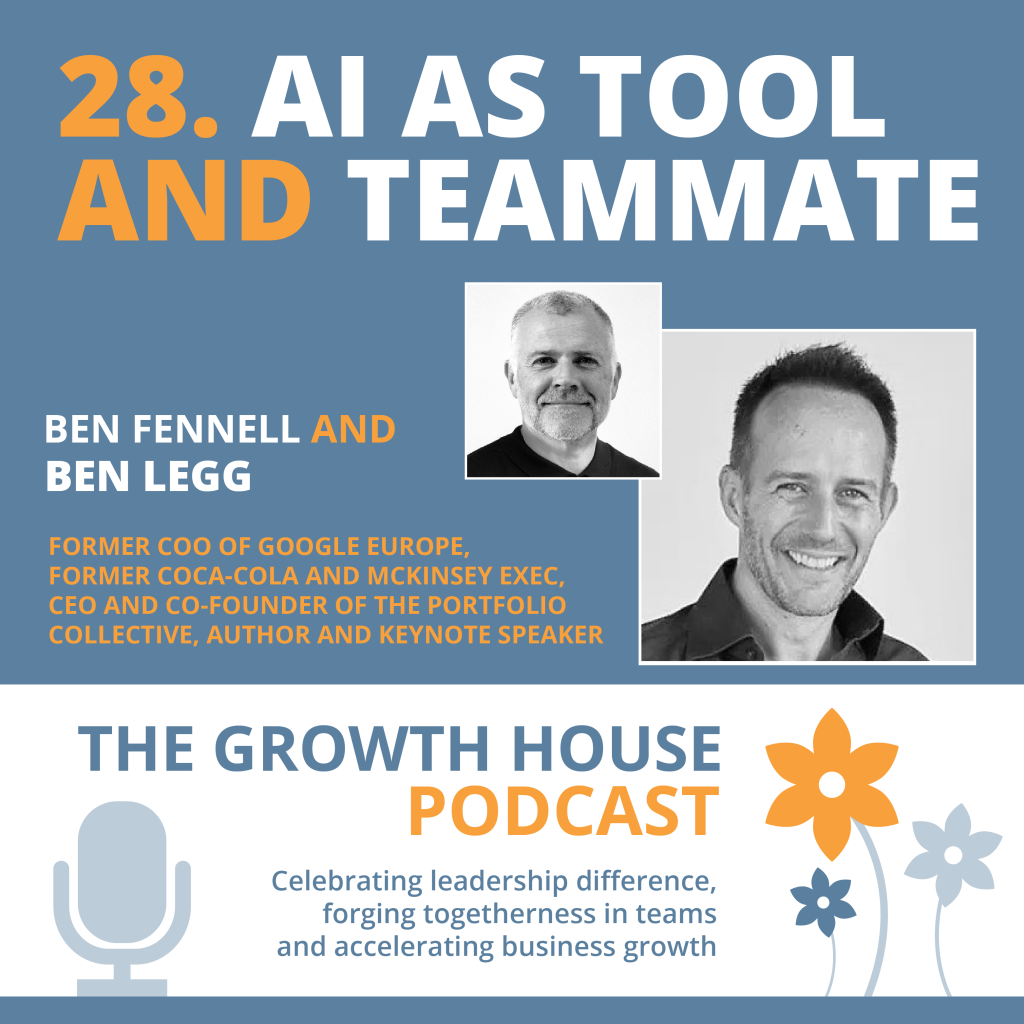
Ben Fennell interviews Ben Legg — a former British Army engineer turned McKinsey consultant, Coca-Cola country manager, COO of Google Europe, and now a portfolio-career AI advisor — about how he’s built one of the most advanced personal/business “agentic” AI setups around.
Legg runs a lean 6-person consultancy where Claude sits at the centre of his tech stack, orchestrating 62 custom AI agents that handle email, calendar, CRM, market monitoring, and more — while Claude itself connects out to specialist tools like Notion, Gemini, Granola, and Xero. He frames AI less as a search tool and more as a “junior teammate” — like a graduate trainee that gets smarter every day if you train it, unlike generic AI which resets each session.
The conversation moves through real-world case studies: Klarna’s public misstep of over-cutting customer support staff before rehiring, and IKEA’s more successful approach of retraining freed-up call centre staff into a design service that now generates $1.3bn in revenue. Legg also highlights how AI is boosting (not replacing) radiologists in the UK, enabling more frequent cancer screening while pay and headcount rise — a live rebuttal to fears that efficiency gains destroy jobs, grounded in the economic idea of Jevons paradox (cheaper capability increases demand rather than shrinking it).
He warns of two common failure modes in organisations: “pilot purgatory” (lots of small individual AI wins with no one tackling the big cross-functional problems) and “shadow AI” (employees using personal AI accounts with company data because official policy is too restrictive or absent). He also stresses that AI transformation almost always uncovers messy underlying data that needs ongoing cleanup, and that budget for AI tools works best when owned by line managers who can trade off cost against value, rather than centralised IT.
On skills, Legg shares a simple four-stage maturity model (not using AI → using generic AI → building a few useful agents → building and measuring full agentic workflows) and argues 2025’s benchmark skill is simply building your own agents, which takes minutes, not months. He also describes using AI playfully with his own children — building storytelling “gems” with Gemini — as a way of teaching AI literacy through fun rather than formal training, echoed by Fennell’s own example of using Suno to turn a birthday poem into a personalised song for his daughter.
The episode closes with Legg’s answers to the show’s standard three questions: leaders should lead AI adoption from the front rather than delegate it; teams should build a culture of openly sharing both AI successes and failures; and anyone chasing growth should use AI to spot new opportunities while constantly reassessing, at every step, what should be done by AI versus humans.
The Growth House Podcast
Inspiring conversations with game-changing individuals


Follow us on Linked In